

NVIDIA, IBM and Fermilab Link GPUs to Quantum Computers
NVIDIA says it will colocate DGX B200 systems with IBM quantum computers and work with Fermilab on error correction. It also released a decoder it says runs up to 13,000 times faster, and added quantum scheduling to Slurm.
By Utopia Data & AI Team6 min read

In brief
- NVIDIA announced on 16 November 2026 a collaboration with IBM and the US Department of Energy's Fermi National Accelerator Laboratory. It will colocate NVIDIA DGX B200 systems with IBM quantum computers, including those built on IBM's Quantum Nighthawk processor.[1]
- Separately, NVIDIA released a decoding algorithm called TCBP-JOBS in its CUDA-Q QEC 0.9.0 library. NVIDIA says it speeds up quantum error-correction research by up to 13,000 times and cuts a 12-week computation to 45 minutes.[1][2]
- NVIDIA also extended the open source Slurm scheduler so supercomputing centres can schedule quantum processors beside CPUs and GPUs. Slurm 26.11 is due later this month. All claims are NVIDIA's own, and we did not test them.[1][2]
What NVIDIA announced on 16 November
NVIDIA announced new collaborations with IBM and Fermi National Accelerator Laboratory on 16 November 2026, during its SC26 supercomputing week. The company says the work spans research into modular quantum computer architectures, scientific applications and links between quantum machines and supercomputers.[1]
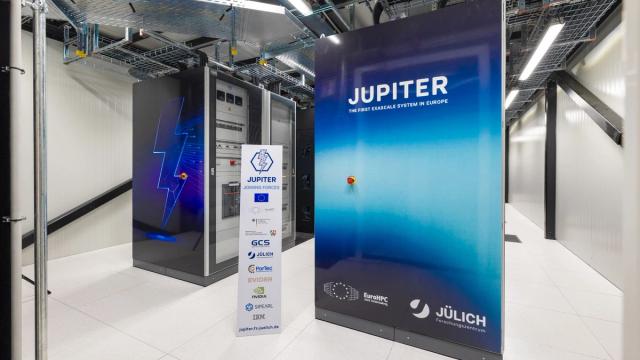
The centrepiece is a modular quantum computing codesign platform built with IBM and Fermilab. IBM and NVIDIA are colocating NVIDIA DGX B200 systems with IBM quantum computers, including machines powered by IBM Quantum Nighthawk, which the release calls the fastest quantum processor IBM has delivered.[1]
This story rests on NVIDIA's press release and a companion NVIDIA blog post, both dated 16 November. The speed-up figures, adoption claims and research results are NVIDIA's, and we have not reproduced or independently checked any of them.[1][2]

The codesign platform with IBM and Fermilab
According to the release, the platform will let researchers develop and evaluate error-correction codes, decoding algorithms and applications that combine quantum and classical computing. Its scientific focus is high-energy and nuclear physics, the field Fermilab works in. It will also study how classical computers can scale alongside several linked quantum processors in a modular design.[1]
Fermilab is expected to concentrate on quantum error correction and physics applications. The release says that work will help define the requirements for future fault-tolerant quantum computers and the science they could support.[1]
Krysta Svore, NVIDIA's vice president of applied research for quantum computing, said making quantum computers useful for science requires advances in error correction, applications and the systems that join quantum processors to accelerated computing. Jerry Chow, an IBM Fellow, said the partners plan to explore how real-world problems can shape the next generation of modular, interconnected architectures.[1]
Anna Grassellino, Fermilab's chief technology officer and director of its SQMS Center, described the platform as proposed. That wording matters. The release speaks of plans and a platform that will support research, so it does not describe a finished facility or published results.[1]
A faster decoder for error-correction research
Quantum processors make errors that limit how long and how complex a calculation can be. Error correction spreads one unit of quantum information across several physical qubits. A classical program called a decoder reads the measurement data and works out which errors probably happened so they can be fixed.[1]
NVIDIA says its new TCBP-JOBS decoder is available today in the CUDA-Q QEC 0.9.0 library. The company says it is up to 13,000 times faster than existing leading algorithms while keeping high accuracy, and that it cuts the computing time for studying new quantum designs from 12 weeks to 45 minutes. The release gives no benchmark method, so the figure should be read as NVIDIA's claim about research workloads.[1]
The companion blog post adds that Fermilab has already used CUDA-Q to run studies in three weeks that would normally take five months. It also lists new CUDA-Q components for fault-tolerant programming, chemistry and materials applications, and for shaping the control pulses that drive qubits.[2]

Quantum chemistry results and the Slurm expansion
The release says IBM and Japan's RIKEN are advancing quantum-classical chemistry research on NVIDIA hardware. Their work, which pairs an IBM quantum computer with RIKEN's GPU supercomputer ROQUO, is a finalist for the 2026 ACM Gordon Bell Prize. The team calculated binding energies for two protein-ligand complexes, a step relevant to drug discovery, and modelled complexes of up to 12,635 atoms. NVIDIA says that is more than 40 times the size of the previous 303-atom quantum-classical benchmark.[1]
The third element is scheduling. NVIDIA is adding a quantum interface to Slurm, the open source workload manager many supercomputing centres use. The release says centres currently rely on custom methods to attach quantum hardware, which creates extra engineering and upkeep. With the change, centres should be able to schedule quantum processors alongside CPUs and GPUs using familiar commands and policies.[1]
The blog post says nearly 30 supercomputing centres are deploying more than 50 quantum processors, and that quantum deployments at such centres have grown almost sevenfold in five years. It names Alice & Bob, IBM, IQM, Pasqal, Quantinuum and MQSC as early adopters of the Slurm work, which supports the QRMI and QDMI interfaces. Slurm 26.11 is due later in November.[2]
What it means for Malaysian readers (our analysis)
Neither source names Malaysia, a Malaysian institution or a Malaysian supplier, so nothing here is a local announcement. The relevance is indirect. NVIDIA is positioning GPU clusters as the control and decoding layer for quantum machines, and it is using Slurm, a scheduler that many research computing teams already run.[1][2]
For a Malaysian university or research group, that suggests current GPU and HPC skills will carry into quantum work, while quantum hardware itself remains expensive and specialised. The release gives no pricing, access terms or timeline for outside users of the codesign platform, so any plan to use it would first need direct enquiries to NVIDIA, IBM or Fermilab.[1]
Why Malaysia should care
Our analysis: Malaysia has no announced role in this collaboration, and the releases name no Malaysian site. The signal for local universities and data centres is practical: quantum research is being built on GPU clusters and standard schedulers, so GPU skills transfer. Treat quantum as a research watch item, not a purchase.
Malaysian university research groups
The work reinforces GPU clusters as the base for quantum research, so existing HPC skills stay useful even though no Malaysian site is named.[1][2]
Practical move: Check whether your cluster scheduler and CUDA skills match the open tools NVIDIA released.
Data centre and HPC operators
Slurm 26.11 is meant to let centres schedule quantum processors with ordinary commands, which lowers integration effort if a centre ever hosts one.[2]
Practical move: Read the Slurm release notes when published and note the QRMI and QDMI interfaces.
Business and technology leaders
The releases describe research platforms and claimed research speed-ups, not products that change commercial workloads today.[1]
Practical move: Track quantum as a watch item and do not budget for it without a stated use case.
What Malaysians can do now
- Read NVIDIA's release and its Slurm blog post in full before repeating the 13,000x figure.
- Ask NVIDIA or IBM directly about access terms if your group wants to use the platform.
- Wait for the Slurm 26.11 release notes before planning any scheduler changes.
What we still do not know
What we still do not know
- How NVIDIA measured the 13,000x decoder speed-up, and what baseline it used.
- Whether researchers outside IBM, Fermilab and NVIDIA can use the codesign platform, and when.
- Whether any Malaysian institution is involved or can take part.
Sources
- NVIDIA Announces Collaboration With IBM and Fermi National Accelerator Laboratory to Launch Quantum-Classical Codesign Platform, Plus Error-Correction Breakthrough to Advance Practical Quantum ComputingNVIDIA Newsroom, 16 November 2026
- NVIDIA Expands Slurm to Bring Quantum Computing Into SupercomputingNVIDIA Blog, 16 November 2026
- File:IBM Q System One (Fraunhofer) installation.jpgWikimedia Commons, 28 May 2021
- File:IBM Q System Two Ikerbasque 01.jpgWikimedia Commons, 14 October 2025
- File:Aerial view of Wilson Hall, Fermilab.jpgWikimedia Commons, 7 September 1999
Facts come from an NVIDIA Newsroom release and an NVIDIA Blog post, both dated 16 November 2026 and read on 20 November. Figures and claims are those NVIDIA reported, and we did not test or audit them. The section marked as our analysis is Utopia's interpretation. The three photographs are licensed contextual images and none shows the announcement. No generated image is used.
Last fact check: 20 November 2026. Factual correction? devteam.utopia@gmail.com.