

OpenAI's MedChemBench Tests Whether AI Can Reason Like a Medicinal Chemist
OpenAI released a benchmark of 99 medicinal-chemistry problems built from 117 published papers and patents. Its best result was 84.5% of available credit, and the company says the benchmark does not show that models can discover new drugs.
By Utopia Data & AI Team6 min read

In brief
- OpenAI introduced MedChemBench on 20 November 2026. It tests whether AI models can link a molecule's structure to experimental evidence in order to explain results, compare compounds and predict properties.[1]
- The benchmark has 99 problems drawn from 117 published papers and patents, covering 761 distinct molecular structures. Four components are graded: structures, scientific reasoning, ranking and selection, and property predictions.[1]
- GPT-6.2 Astra scored 84.5% of available credit at xhigh reasoning. OpenAI says the results do not establish whether models can discover new drugs or improve laboratory decisions.[1]
What OpenAI released on 20 November
OpenAI introduced MedChemBench on 20 November 2026, filed under research, release and science. The benchmark asks whether a model can connect the structure of a molecule with experimental evidence, to support medicinal chemists who must balance competing properties when improving a drug candidate.[1]
For most problems, a model receives the biological target, the researchers' goals, the compounds studied so far and selected experimental findings from a chosen point in a research programme. OpenAI says a paper is linked on its page.[1]
This story rests on OpenAI's own page. The scores are OpenAI's, from single attempts without tools, and we have not reproduced them. The page names no outside partner.[1]

How MedChemBench is built and graded
The 99 problems come from 117 papers and patents and cover 761 distinct structures. Four parts are graded: whether the model draws correct atom connections and stereochemistry, whether its scientific explanation fits the supplied evidence, whether its rankings and selections meet stated requirements, and whether its numerical and categorical predictions agree with reported values.[1]
One example concerns PRMT5, a cancer drug target. The model sees structures and earlier results, then predicts three related compounds' PRMT5 inhibition in cells, ability to cross a cell barrier and breakdown rate by liver enzymes. Later withheld experiments showed a trade-off. Compound 23 blocked PRMT5 at a lower concentration, while compound 24 crossed the barrier more readily and broke down more slowly.[1]
Predictions earn partial credit based on closeness to the measured values. Measurements already given in the prompt must be reproduced correctly.[1]
What the scores show
At xhigh reasoning, OpenAI reports GPT-6.2 Astra at 84.5% of available credit, GPT-6 Astra at 83.3%, GPT-6.1 Sol at 82.0%, GPT-6.1 Terra at 75.1% and GPT-5.6 Sol at 58.2%. GPT-6 Astra reached 83.8% at max effort.[1]
OpenAI evaluated eleven GPT models at different reasoning settings. Its second figure plots 51 combinations across nine models from GPT-5.6 onward, averaged over the 99 problems with 95% uncertainty intervals. Higher reasoning settings improved scores, yet large gaps between models remained.[1]
GPT-6 Astra was strongest at rebuilding molecular structures, with 95.4% of structure credit at xhigh, and at explaining experimental evidence. It earned only about half the available credit for compound selection and numerical property prediction.[1]

A spatial test case and the stated limits
In one spatial task, a model must assemble a molecule from a central structure and two attached groups while keeping an 18-atom ring. At xhigh reasoning, GPT-6 Astra did it correctly in all ten responses. GPT-5.6 Sol and GPT-5.6 Luna failed all ten. Sol produced a 15-atom ring, and Luna produced two disconnected fragments.[1]
OpenAI lists limits. It says the results do not establish whether models can discover new drugs or improve laboratory decisions. It cannot rule out that models saw the published sources in training. Each response was a single attempt with no tools, feedback or new experiments.[1]
OpenAI says it expects the benchmark to support continued progress and plans to share updates. It gives no date for those updates.[1]
Why Malaysia should care
Our analysis: OpenAI names no Malaysian partner. Malaysian universities and pharmaceutical groups that explore AI for drug research can read this as a method for testing models on structure, ranking and property prediction before trusting them. The benchmark's stated limits mean it is not a substitute for laboratory validation.
Malaysian university chemistry and pharmacy groups
The four-part grading offers a template for testing a model on structure, reasoning, ranking and prediction before using it in research.[1]
Practical move: Borrow the four parts to build a small local test from your own papers.
Malaysian pharmaceutical and biotech firms
The strongest scores are on structure and explanation. Selection and numerical prediction scored near half, so those tasks still need chemist review.[1]
Practical move: Keep chemists in charge of selection and property decisions.
Business and technology leaders
A benchmark score is not evidence of a laboratory result, and OpenAI says so itself.[1]
Practical move: Do not budget for AI drug discovery on this score alone.
What Malaysians can do now
- Read OpenAI's page and linked paper before quoting the 84.5% score.
- Check whether your own tests use data the model may have seen in training.
- Keep laboratory validation as the deciding step for any AI-suggested compound.
What we still do not know
What we still do not know
- Whether training exposure to the published sources inflated the scores.
- How the models would score on unpublished, new chemistry.
- Whether OpenAI will release the full benchmark for outside use.
Sources
- Can AI help scientists identify promising drug candidates?OpenAI, 20 November 2026
- File:Generic Drug Research (5896) (8493711422).jpgWikimedia Commons, 8 February 2013
- File:Generic Drug Research (5915) (8493716336).jpgWikimedia Commons, 8 February 2013
- File:Generic Drug Research (5956) (8493712946).jpgWikimedia Commons, 8 February 2013
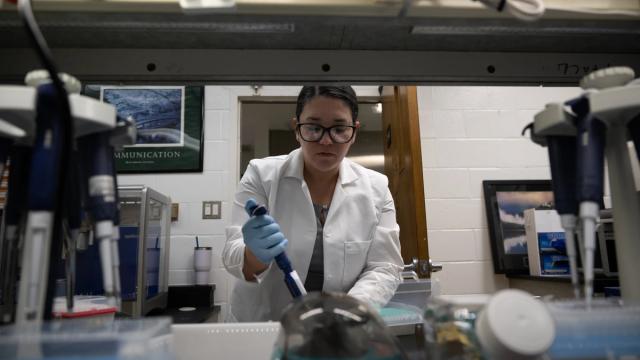
Facts come from OpenAI's own page dated 20 November 2026, read on 21 November. Scores and claims are those OpenAI reported, and we did not test or audit them. The section marked as our analysis is Utopia's interpretation. The three photographs are public-domain US Food and Drug Administration images of generic-drug laboratory work and show nothing from OpenAI or MedChemBench. No generated image is used.
Last fact check: 21 November 2026. Factual correction? devteam.utopia@gmail.com.