

MIT's Insect-Scale Flying Robot Now Carries Its Own Sensors and Computer
MIT researchers say their paperclip-light flapping robot now carries a 244 milligram sensor and computing package, so it no longer needs a motion-capture system. It still draws power from an outside source, and no camera is onboard yet.
By Utopia Data & AI Team6 min read
In brief
- MIT News reported on 18 November 2026 that MIT researchers built an insect-scale flapping-wing robot that carries its own sensors and computer, so it flies without an attached motion-capture system.[1]
- The team made the soft artificial muscles 50 percent larger and raised net lift by 46 percent. That let the robot, which weighs less than a paperclip, carry a 244 milligram electronics package.[1]
- The robot hovered and followed paths with errors of a few centimetres, and landed on a sunflower. It is still tethered to an outside power source and has no camera. The claims are the researchers' own.[1]
What the MIT researchers announced
MIT News reported on 18 November 2026 that researchers at the Massachusetts Institute of Technology built an insect-scale flying robot that carries its own sensors and computing hardware. Earlier versions could only fly inside a laboratory, tied to a motion-capture system. The new work is described as a step toward uses such as agriculture and industrial inspection.[1]
The paper, titled "Controlled Flight of an Insect-Scale Flapping-Wing Robot via Integrated Onboard Sensing and Computation," appears in Science Robotics under DOI 10.1126/scirobotics.aeg6618. Kevin Chen, an associate professor in MIT's Department of Electrical Engineering and Computer Science, and Jonathan P. How, the Ford Professor of Aeronautics and Astronautics, are co-corresponding authors. Graduate students Yi-Hsuan (Nemo) Hsiao, Quang Phuc Kieu and Zhongtao Guan are co-lead authors.[1]
This story rests on MIT's own article. The results are the researchers' claims. We have not read the full paper or seen the robot fly.[1]

The limit of earlier microrobots
The article says the same MIT group had already built small aerial robots with bumblebee-like speed, agility and durability. They were meant for jobs such as precision agriculture and search and rescue. The earlier design had four wings, each driven by soft artificial muscles, called actuators, that flap rapidly.[1]
The robot is roughly the size and shape of a microcassette and weighs less than a paperclip. Its main limit was that it could not carry the electronics needed to find its own way. To fly, it had to stay connected to a motion-capture system in the lab, which tracked it with external cameras.[1]
Chen calls the new result a really important milestone for the research community. He describes it as the first demonstration of an aerial microrobot that is autonomous in both sensing and computing. That description is his, and the article does not point to an independent assessment.[1]
More lift, then a lighter brain
The team first needed more payload. It scaled up the artificial muscles by tuning the radius and length of the soft actuators. The article says the actuators grew by 50 percent while net lift rose by 46 percent. Chen notes that making actuators bigger usually lowers their power output and so their lift, which the team avoided by tuning the geometry.[1]
The result was a lift-to-weight ratio of 1.9, enough to carry a 244 milligram electronics package. It includes an inertial measurement unit to estimate attitude, an optical flow sensor to estimate sideways speed and position, a time-of-flight sensor to measure height, and a microcontroller for sensing and computation. A fibreglass substrate keeps wing vibration away from the sensors.[1]
Without motion capture, the robot does not know its absolute position and drifts. The team designed an algorithm that estimates orientation, angular velocity and position quickly, with simplified calculations to save computing effort. Hsiao says estimating position continuously at a higher rate worked better than a slower, more precise estimate.[1]

What the team reports
In flight tests, the robot hovered at different heights and followed point-to-point paths, with position errors of only a few centimetres. Hsiao says the accuracy is comparable to flying with cameras outside the robot. The article does not give the number of flights or the exact error figures.[1]
In a pollination demonstration, an operator used a joystick to send high-level position targets. The robot flew around several plants and landed carefully on a sunflower. Hsiao calls the landing quite difficult to do, even with a motion-capture system.[1]
The electronics use only about 6 percent of the robot's total power. The rest drives the artificial muscles and wings. The team says it has found ways to cut electronics power further, which would leave room for extra parts such as a camera.[1]
Limits and what comes next
The robot is still tethered to an outside power source, and it has no camera. That means it cannot yet recognise objects or avoid obstacles. Flying outdoors without a tether is described as a future goal, not a current result.[1]
The researchers plan to add an onboard camera for object recognition and obstacle avoidance. They also plan to integrate power electronics and batteries so the robot can fly untethered outdoors.[1]
The article suggests uses in pollination, where natural pollinators have declined from habitat loss, in crop monitoring, and in industrial surveillance where bigger robots cannot fit. It names almond orchards and blueberry bushes as examples. The work was funded by the US National Science Foundation, the US Office of Naval Research, the US Air Force Office of Scientific Research, MathWorks and a Zakhartchenko Fellowship.[1]
Why Malaysia should care
Our analysis: MIT names no Malaysian partner, and the article describes a laboratory robot, not a product. Malaysian growers, plantation researchers and engineering faculties can read it as an early signal for pollination and crop-scouting robots. The article reports no price, release date or outdoor trial, and the robot is still tethered for power. Any local use is years away and would need testing in tropical field conditions that the article does not cover.
Malaysian growers and plantation researchers
The article names pollination and crop monitoring as goals. It reports no field trial, and the robot is still tethered.[1]
Practical move: Treat this as a long-term research signal, not a purchase.
Malaysian engineering faculties
The paper joins sensing, control and small-scale hardware, which makes it useful teaching material.[1]
Practical move: Read the Science Robotics paper and note how the sensing algorithm was simplified.
Robotics and drone firms
Insect-scale flight with onboard sensing is shown only in a laboratory so far.[1]
Practical move: Watch for an untethered flight demonstration before planning any partnership.
What Malaysians can do now
- Read the Science Robotics paper before quoting the lift and power figures.
- Ask whether any test was run outdoors, in wind or in an orchard.
- Watch for an untethered flight with a camera before planning any pilot.
What we still do not know
What we still do not know
- How many flights were tested, and the exact position errors.
- Whether the robot can fly untethered and outdoors.
- Whether the work will lead to a product, and at what cost.
Sources
- This featherweight, flying robot carries its own sensors and computersMIT News, 18 November 2026
- File:Flying bumblebee.jpgWikimedia Commons, 13 July 2008
- File:Bee Pollinating Sunflower in Colorado (42980105935).jpgWikimedia Commons, 1 August 2018
- File:20140225-OC-DK-0002 (12813166013).jpgWikimedia Commons, 25 February 2014
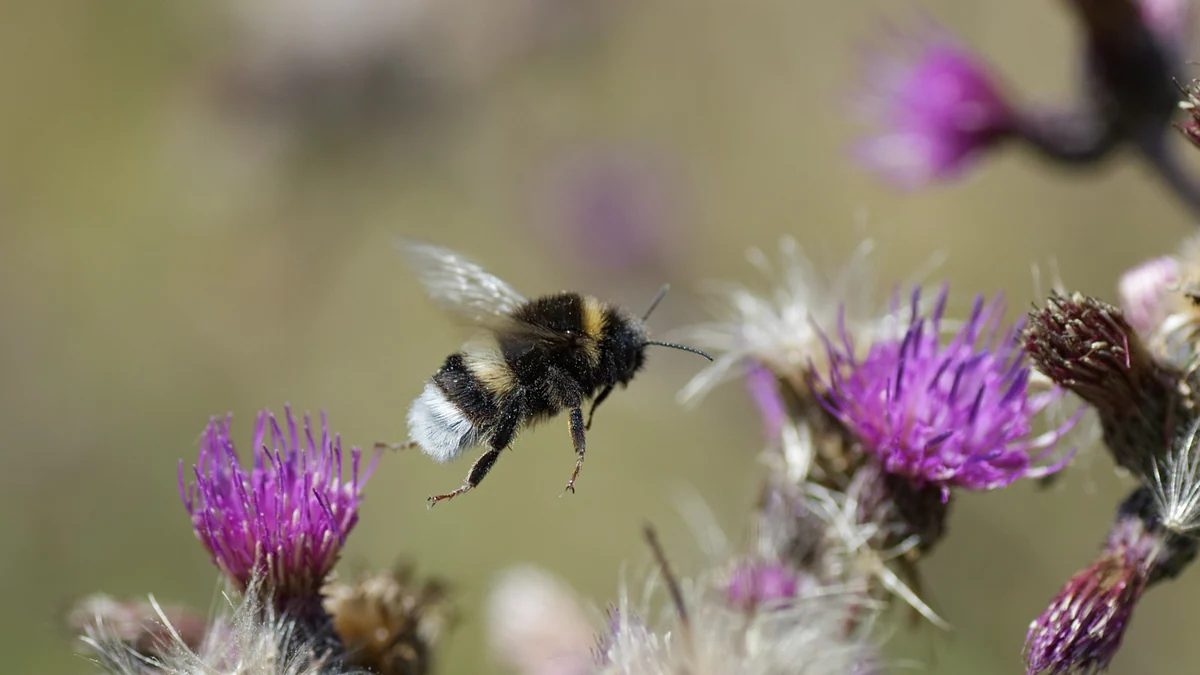
Facts come from MIT News dated 18 November 2026, read on 23 November. Results and claims are those the researchers reported, and we did not run or audit the robot or read the full paper. The section marked as our analysis is Utopia's interpretation. The three photographs are contextual: a flying bumblebee, a sunflower in a Colorado field and a bee on an almond blossom in California. None shows the MIT robot, and no generated image is used.
Last fact check: 23 November 2026. Factual correction? devteam.utopia@gmail.com.