

Singapore Welcomes Mistral's New Asia-Pacific Office and Science Hub
Senior Minister of State Tan Kiat How used the opening to argue that Singapore should be a place where frontier AI is tested in factories and warehouses, but the remarks give no headcount or budget.
By Utopia Data & AI Team5 min read

In brief
- Singapore's Ministry of Digital Development and Information published remarks by Senior Minister of State Tan Kiat How at the opening of Mistral's Asia-Pacific office on 20 November 2026.[1]
- The minister said Mistral will grow its Singapore technical team, including model post-training and applied engineering, and pointed to an Asia-Pacific Science Hub focused on AI in the physical world.[1]
- The remarks give no headcount, investment figure or opening date for the Science Hub. Mistral's earlier Singapore deals, announced in May 2026, include a partnership with HTX and memoranda with three firms.[1][2]
What the ministry reported
Singapore's Senior Minister of State for Digital Development and Information, Tan Kiat How, spoke at the opening of Mistral AI's Asia-Pacific office in Singapore on the evening of 20 November 2026. The Ministry of Digital Development and Information (MDDI) has published his remarks. They are the only first-hand record of the event that we have read.[1]
The minister greeted the French ambassador to Singapore, Stephen Marchisio, and named Mistral's Audrey Herblin-Stoop and Geoff Soon. He called the occasion a momentous one and congratulated the team on the office.[1]
Most of the speech was about what Singapore wants from the arrival. He said the global AI race has so far asked how capable models can become, and that a second race now matters just as much: how capable AI can make industries, businesses and people.[1]

Why the minister says application is the bottleneck
Tan said powerful models and computing infrastructure remain important. In his view the next bottleneck is application: adapting AI to real problems, fitting it into complex operations and proving that it works reliably and creates value. He listed what that takes. Engineering, research, industry knowledge and close partnerships between the people who build AI and the people who use it.[1]
He then set out Singapore's stated ambition. The country does not want to be only a market for frontier AI, he said. It wants to be a place where frontier AI is developed, adapted and put to work, with solutions that can travel from Singapore to the rest of the world.[1]
He added a line about scale. Singapore is a small economy and may not be the world's largest market, he said, but it can be one of the best places to prove what AI can do in the real world. That claim is the minister's own and the speech offers no data behind it.[1]
The HTX partnership and the May agreements
The minister called Mistral's partnership with HTX a good example. HTX is Singapore's Home Team Science and Technology Agency. Through a project he called Phoenix, he said, Mistral and HTX have adapted AI models for Singapore's context and public-safety needs. He stressed that the value lies in the capability built by working on the problem together, not in access to a model alone.[1]
The partnership was first reported in May 2026. Intelligent CIO wrote on 12 May that Mistral would give HTX infrastructure for high-performance inference and fine-tuning, plus a developer toolkit, and would help train HTX staff. The same report says Mistral signed memoranda of understanding with Singtel, NCS and ST Engineering. That article does not mention Phoenix, so the link between the two comes only from the minister's remarks.[1][2]
The minister said he was encouraged that Mistral will grow its technical team in Singapore, including in model post-training and applied engineering. He argued that the office and the headcount matter less than the capability that grows around them: researchers on harder problems, engineers with experience of frontier technology, and companies that learn to adapt AI to their operations.[1]

The Science Hub and AI in the physical world
Tan said he was especially excited about Mistral's Asia-Pacific Science Hub in Singapore. His reasoning was that much of the recent AI wave has centred on what AI can write, analyse or tell people, and that the next frontier is what AI can do in the physical world. He described robots that perceive better, adapt to changing situations, handle unfamiliar objects and work more safely alongside people.[1]
Singapore, he said, offers demanding places to test this. Its manufacturing and logistics sectors provide real problems, real constraints and real users. The hard part, in his words, is not producing an impressive demonstration but making prototypes work safely, reliably and economically. He tied that to trust, saying reliability and assurance will matter more as AI moves from generating answers to taking actions.[1]
He also named advanced manufacturing as one of Singapore's National AI Missions. The approach he outlined has four steps: bring frontier AI companies, researchers, engineers and industrial users together, work on consequential problems, test what works in a real environment, then scale the solutions beyond Singapore.[1]
Resilience through many partners
The minister also framed the opening as a matter of resilience. For a small and open economy, he said, resilience does not come from trying to be self-sufficient in everything, which he called neither practical nor technically achievable. It comes from working with many strong partners while building deep capabilities inside Singapore. He described Mistral as another important layer in that ecosystem.[1]
He closed by welcoming the Mistral team and urging them to build, solve and learn in Singapore, and to take what works to the world. He said some of the visitors were in Singapore for the first time and that he hoped it would not be the last.[1]
Why Malaysia should care
Our analysis: Malaysian manufacturers and logistics firms sit next to the test bed Singapore is describing, so the plan matters even though Mistral announced nothing for Malaysia. The minister's own test is practical. A model must work safely, reliably and at an acceptable cost on a real floor, not only in a demonstration. A Malaysian operator can borrow that test when any vendor, from any country, pitches an AI system. Ask for a trial on one real task, with measured error rates and a named person responsible. The remarks do not say whether Mistral will serve customers outside Singapore from this office, or whether Malaysian companies can join the Science Hub work. Until Mistral says so, treat any cross-border benefit as possible, not promised. That is our reading, not a claim by the ministry or the company.
Manufacturers and logistics firms
Singapore is offering its factories and warehouses as a test bed for physical AI, and says reliability and cost decide success.[1]
Practical move: Ask any AI vendor for a measured trial on one task before you sign a contract.
Engineers and researchers
Mistral says it will hire in model post-training and applied engineering in Singapore.[1]
Practical move: Watch Mistral's own job listings for the roles, rather than relying on the speech.
What Malaysians can do now
- Read the MDDI remarks in full before quoting the minister.
- Treat Science Hub plans as intentions until Mistral publishes dates and figures.
- Test any physical-AI pitch on one real task with measured results.
What we still do not know
What we still do not know
- How large the Singapore office is today, and how many people Mistral plans to hire.
- What the Science Hub will build first, how much it costs and when it opens.
- What Phoenix has produced for HTX, and under what terms.
- Whether Malaysian or other regional firms can take part in the Science Hub work.
Sources
- Remarks by SMS Tan Kiat How at the Opening of Mistral's Singapore OfficeMinistry of Digital Development and Information, Singapore, 20 November 2026
- Mistral AI accelerates Singapore expansion with strategic partnership and industry collaborationsIntelligent CIO APAC, 12 May 2026
- File:Skylines of the Central Business District, Singapore at dusk.jpgWikimedia Commons, 10 June 2018
- File:043 MNACTEC (Terrassa), exposició temporal Robots, àmbit dels robots humanoides.jpgWikimedia Commons, 20 September 2026
- File:Skyline, Marina Bay, Singapur, 2023-08-17, DD 20.jpgWikimedia Commons, 17 August 2023
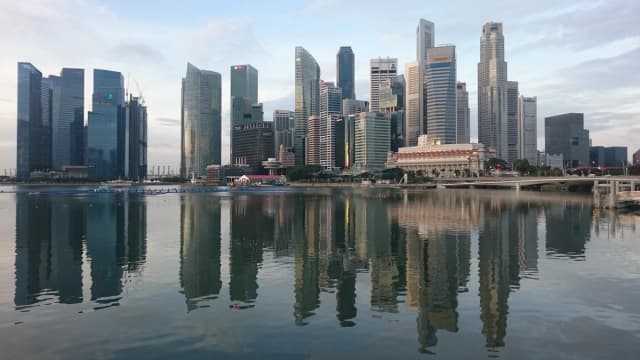
Facts come from the ministry's published remarks of 20 November 2026 and one trade report of 12 May 2026, both read directly on 28 November. We did not attend the opening and did not read a Mistral release. The section marked as our analysis is Utopia's interpretation. The three photographs are contextual Wikimedia Commons images. None shows Mistral, its office or the event, and no generated image is used.
Last fact check: 28 November 2026. Factual correction? devteam.utopia@gmail.com.